Wednesday, March 1, 2017

Pep Guardiola's tactics are not the issue for Manchester City's defence

Pep Guardiola's tactics are not the issue for Manchester City's defence

 / Wong Brebes

Man City's error-prone defence was exposed again by Monaco but who is to blame for it? Adam Bate attempts to separate fact from fiction regarding the defensive record of Pep Guardiola's team and the reasons for their problems at the back this season...

An improved sequence of six games in which Manchester City conceded only one goal was enough to encourage the idea that the club's defensive worries of earlier in the campaign were now behind them. That notion was undermined along with the City back line during the course of a memorable and at times maddening 90 minutes against Monaco last week.
Victory was the priority and that was duly secured thanks to an amazing turnaround as Pep Guardiola's side scored three times in the final 20 minutes to win 5-3 as Monaco faded. It really ought to be enough to ensure City's progress in the tie but how far they can go both domestically and in Europe is surely limited unless their defensive issues are addressed.
And those problems would appear to be manifold. Neither of the club's current goalkeepers inspire much confidence, questions remain over the centre-backs, while even Guardiola's plans and preferences for the full-back roles remain something of a mystery. So are City's flaws as a result of bad luck and individual errors or is this a team that is set up to fail?
Goalkeeper
Willy Caballero actually made a wonderful save with his feet from Radamel Falcao late on against Monaco as well as denying the striker from the spot. However, the 35-year-old Argentine's limitations are well known and the very fact that Guardiola has turned to him reflects the problems that Claudio Bravo has endured since arriving in the Premier League.
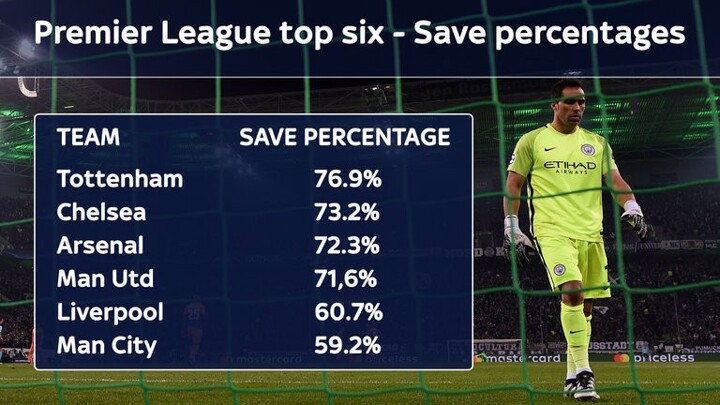
Between them, City's goalkeepers are saving just 59.1 per cent of the shots they have faced this season. That puts them among the bottom three in the division and is inferior to all of their main rivals near the top of the table. Tottenham are up at 76.9 per cent with Chelsea, Arsenal and Manchester United's goalkeepers all up above the 70-per-cent mark.
Save percentage stats can be misleading, of course, as they do not take into account the quality of the shots being faced. For example, it was easy to criticise Bravo's goalkeeping in the 3-1 home defeat to Chelsea earlier this season but when Diego Costa, Willian and Eden Hazard each find themselves clean through on goal perhaps there are bigger issues.
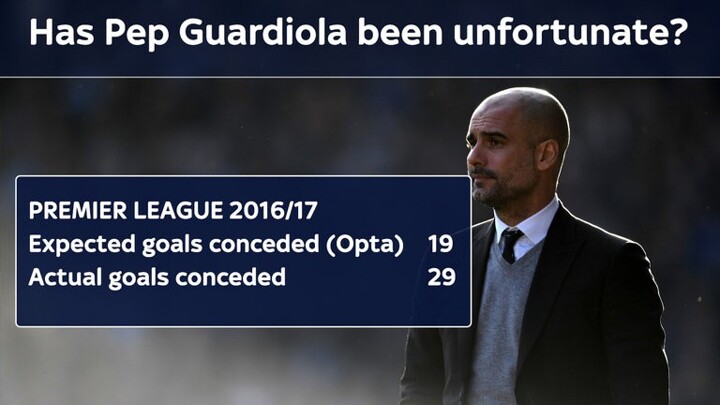
And yet, delve deeper and not only are Bravo's failings clear but a new picture emerges. Opta's expected goals model calculates the goals that a team might expect to concede based on shot-location data. This suggests City should have let in 19 goals this season - the same as leaders Chelsea have actually conceded. Instead they have in fact let in 29 goals.
So while Guardiola is culpable for ousting Joe Hart from the squad in favour of the Chilean, these statistics would at least suggest there is not a fundamental stylistic problem preventing the team from keeping clean sheets - as might be expected from a coach whose teams have boasted the best defensive record in each of his seven seasons in management.
Defence
The oft-cited argument against Guardiola's methodology is that it is not easily transferable. The theory is that these players are not capable of doing what his previous ones were able to do defensively. It's an alarming prospect given that Nicolas Otamendi and John Stones are the most expensive assembled centre-back partnership currently in world football.
But on the face of it they are struggling to convince as a pair with even the fundamentals of defending seemingly proving a challenge. It was a simple ball over the top that did for them against Monaco and even at 29 years old it appears that Otamendi is not the man to provide the assurance that is required alongside a younger defender such as Stones.
The Englishman has made three high-profile errors in the Premier League this season. No player in the country has made more. He was partially responsible for Southampton's opening goal at the Etihad in October as well as the fourth goals for both Leicester and Everton in perhaps the two most spectacular defeats of Guardiola's brief reign so far.
But once again the true picture is not quite so clear. While it is true that Stones has made three errors leading to goals in the Premier League this season, according to Opta, these also happen to be the only three mistakes he has made leading to a shot on goal. Stones has indeed found himself embarrassed, but he has been punished heavily for his slip ups.
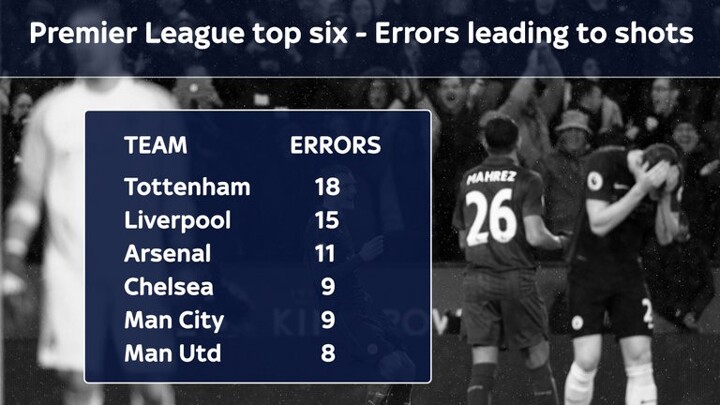
In fact, City's total of nine errors leading to shots under Guardiola is far better than most. Again, this is the exact same number that Chelsea have made. Both Liverpool and Arsenal have more mistakes to their name. Tottenham have twice as many. City's style might be perceived as high risk but there is little evidence it is significantly undermining their chances.
Conclusion
Some will struggle to be convinced by that. They will see Caballero surrendering possession in his own half because of a dogmatic determination to pass the ball out from the back, as he did six times against Monaco, and conclude that Guardiola's entire philosophy must be subject to a rethink before Manchester City can truly make progress.
But Guardiola is not going to lose faith in his methods. That is, as he has repeatedly stated, impossible. "It is not about the system," he said after the 4-2 defeat to Leicester in December. What he might eventually conclude is that it is about making the necessary changes in personnel - maybe even admitting to mistakes over the goalkeeper position.
Despite being widely seen as a stubborn character, Guardiola has shown some humility in this regard. "At times my ideas were not good," he said in January, "because I'm still getting to know the players, the best way to play and to adapt to them. Sometimes I have an idea - three at the back or play a player in a certain way - and sometimes it didn't work."
But if City can save more shots and if their defence is not punished quite so often, belief will grow. "The moment we feel mistakes, especially in defence, we lose a little confidence to play," he said recently. Mistakes make a mockery of the best laid plans. But the evidence is there - at City now as well as at Bayern and Barca - that the Guardiola plan really does work.

Premier League title winners: Myth busting the champions' traits

 / Wong Brebes

They say to win the Premier League you must score the most, concede the fewest, and have a 20+ goal striker.
You need a mix of youth and experience, you must beat the teams around you, and of course, you have to spend the most dosh.
But are these just false assumptions, or real, title-winning traits? Sky Sports take a deeper look, and you may think again before blurting out the following phrases...
Score the most goals
Let's start off with an easy one.
Most of the time, that's true, but only just. More often than you'd assume, title winners are not the top scorers in the Premier League - only 62.5 per cent net the most goals.
Fifteen of the 24 Premier League champions since 1992/93 have been top scorers, notching on average 79 goals.
Manchester United scored just 67 goals in the 1992/93 season, despite playing 42 games, with goals in the early Premier League seasons spread more across the division than modern times. Even Blackburn Rovers, who finished 13 points behind United in fourth place, scored more.
Concede the least goals
Not true, most of the time. Manchester United boss Jose Mourinho said former side Chelsea would win the title this season due to their superior defensive record.
But only 42 per cent (10 out of 24) of Premier League champions have held the best defensive record.
And what about clean sheets? Only seven of the 24 title winners have the best clean-sheet record. That's just 29.1 per cent.
Have 20+ goal players
Here's one you'll be re-thinking.
''If I don't get the service, I can't score," said Wayne Rooney in 2010. "If I don't score, I expect others to. We share the goals out well and it's certainly not just about me. We expect to win as a team, not as individuals.''
Rooney's idea of a successful team is in many ways correct. Only 13 of the 24 Premier League winners had players who scored over 20 goals in a season, just 54.1 per cent.
Yes, Blackburn may have struggled with a lesser alternative to Alan Shearer's 34 goals in 1994/95, and nobody is saying the likes of Cristiano Ronaldo, Thierry Henry and Ruud van Nistelrooy didn't help their sides' cause, but the age-old theory that a hit man is imperative to success just isn't true.
In fact, the likes of Eric Cantona (1992/93 - 15 goals; 1995/96 - 14 goals), Teddy Sheringham (2000/01 - 15 goals) and Frank Lampard (2004/05 - 13 goals) were their club's top scorers in title-winning seasons, but far off the golden boot gong.
Conclusion? Reliance on just one striker is not a good thing, and a share of the goals usually helps spread the load.
Beat the teams around them
There's a decent case for this. Three points are three points, whether they come against the basement boys or your nearest challengers, but in the last 10 seasons, title winners tend to come either first or second in their top-four mini-league.
No Premier League side since 2006/07 have taken maximum points from their top-four rivals, though Manchester City (2011/12) and Chelsea (2009/10) came close with 15 points out of a possible 18.
It's a mixed bag. Manchester United won just one of their six clashes against other top four sides in their victorious 2008/09 campaign, while Arsenal have finished top of the mini-league pile on three occasions in the past decade, but have nothing to show for it.
But the average top-four points haul of Premier League champions is 10.1 out of 18, suggesting solid form against your rivals helps.
Have managers with a successful playing career
Not necessarily true. Only four of the eight Premier League-winning managers have had international caps,
Arsene Wenger did not have a playing career to shout about, while Mourinho became a coach at the age of 34. Sir Alex Ferguson, meanwhile, was appointed manager of East Stirlingshire at the age of just 32.
Antonio Conte, who won multiple honours with Juventus and earned 20 Italy caps, would slightly buck the trend if his Chelsea side are successful come May.
Have a mix of experience and youth
Correct.
The average age of a title-winning side is 26.7, which is on average the 11th oldest throughout the 24 past Premier League seasons. A nice middle-ground...
Spend the most money
Not true, at least in the past decade. Only once in the last nine seasons has a Premier League champion had the highest net spend - Manchester City in 2013/14 (£102m).
The lowest net spend of a Premier League title-winner since 2007 were Manchester United in 2010/11 (£11m), bringing in the likes of Chris Smalling and Javier Hernandez, while selling Ben Foster and Zoran Tosic for decent sums.
This year's leaders Chelsea are also following the trend; their net spend was far less than Manchester United and Manchester City in the summer window, and Conte's side managed to pick up a cool £62m in January without spending a penny. If they win the title, they will have done so with a net spend of just £35.65m.
The typical net spend of a Premier League champion since 2007/08 is not much higher, at £43m, which is on average the 5th highest. Not exactly frugality, but astute spending seems to be the way forward.
Have the most shots
If you don't buy a ticket, you can't win the raffle.
Four of the last 10 title winners have registered the most shots on goal, with champions averaging third highest shooters since 2006/07. Champions average 661 shots on goal in the season, at 17.4 per game.
Have the best discipline
Most definitely not. Ferguson's famous United sides weren't exactly cordial, and attitude was the hallmark of Wenger's three title-winning Arsenal sides.
Only one Premier League champion has finished a season with the best disciplinary record - Manchester United in 2002/03 - with Roy Keane the only player sent off in the entire league season.
Leicester ran them close last season, picking up three double-yellows but no straight reds, but on average title winners have finished eighth in the fair play table.
The lowest a title-winner has finished in the disciplinary table is 17th; Wenger's Arsenal in 2001/02 saw Ray Parlour sent off three times, and Oleg Luzhny, Giovanni van Bronckhorst and Patrick Vieira dismissed once each.
Have the most possession
Most of the time, that's not true. Only one title winner since 2006/07 has had highest average possession (Manchester United 06/07 - 59.58 per cent), with the last 10 title winners averaging 56.34 per cent of the ball.
Leicester are the obvious anomaly, registering 42.43 per cent average possession last season, and on the whole football seems to be slowly shifting away from a possession-based dominance.
Statistics from the last 10 years of the Premier League show a dramatic change in use of the ball and just how many sides are happy to let the opposition have a go. And why not let them?
In the 2007/08 season, just 19 sides won with less than 40 per cent possession. In 2014/15 that figure was up to 46 and last season was at 52.
Win the most penalties
It's not rocket science. Good teams tend to spend more time in the penalty area than bad ones, so more spot kicks are a given.
But it may surprise you that only twice in the last 14 seasons has a Premier League champion been awarded the most penalties (Leicester 2015/16 - 13 pens; Chelsea 2009/10 - 12 pens).
The average number of penalties awarded to a title-winning side since 2002/03 is 6.7, and the champions tend to come around fifth in the penalty-award table. Not as cut and dried as you might expect.